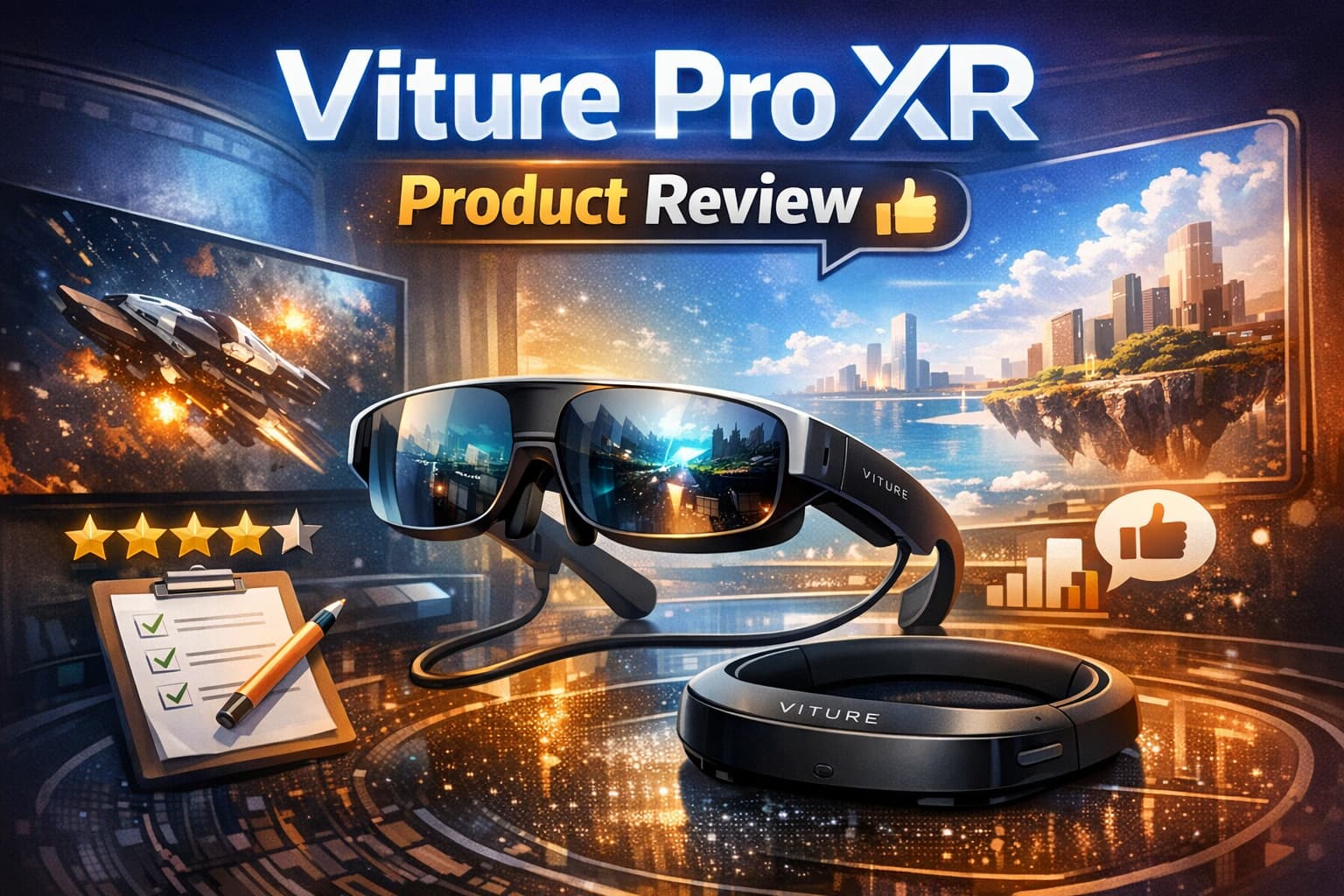
Image source: Amazon / VITURE
Viture Pro XR Review: Bright, Wide, and Built for Entertainment
Bottom line: The Viture Pro XR are the best AR display glasses for HDR movie watching and gaming in bright environments. The 1000-nit perceived brightness with HDR support is best-in-class, and the wider field of view (compared to earlier Viture models) creates a convincingly cinematic experience. Like all glasses in this category, they're tethered to a USB-C source by default, and the optional Neckband accessory adds standalone capability. Strong competition to the Xreal Air 2 Pro and Rokid Max 2.
Quick Specs
| Spec | Details |
|---|---|
| Price | $459 (glasses) / check current Amazon pricing |
| Weight | ~78g |
| Display | Dual micro-OLED, 1920×1080 per eye |
| Refresh Rate | Up to 120Hz |
| Field of View | ~43° |
| Brightness | Up to 1,000 nits (perceived, with Neckband), 4,000 nits peak micro-OLED |
| HDR | HDR10 support |
| Connectivity | USB-C DisplayPort (glasses) / Wi-Fi + Bluetooth (with Neckband) |
| Diopter Adjustment | -5.0D to +2.0D |
| Audio | Built-in open speakers |
| Neckband | ~$169 (standalone Android processing unit) |
Who Makes Viture and What's the Pro?
Viture is a Chinese AR glasses company founded in 2021 by former OPPO and Qualcomm engineers. Their original Viture One was their debut product; the Pro XR is a significant upgrade focused on brightness, wider FOV, and HDR content.
The "XR" designation signals extended reality features beyond the basic display-only model: the Viture Pro XR has better lenses, HDR content support, and is designed as the centerpiece of Viture's SpaceWalker spatial computing experience (available via the Neckband processing unit).
Display Quality
The Viture Pro XR's display stands out in one key area: brightness. Where the Xreal Air 2 Pro peaks at 500 nits and the Rokid Max 2 hits 600 nits, the Viture Pro XR reaches 1,000 nits perceived brightness with HDR content. This matters practically: HDR movies look like HDR movies. Highlights bloom appropriately, dark areas hold detail, and the overall image feels more like a cinema experience than a monitor substitute.
The 1920×1080 micro-OLED display at 120Hz is technically comparable to the Xreal and Rokid. Where Viture differentiates is in the HDR pipeline — the display and processing chain are tuned for HDR content playback, which the competition handles less well.
The 43° field of view is narrower than the Rokid Max 2's 50° but functional for media. At viewing distance, it simulates a very large screen — Viture's marketing claims "equivalent to a 135-inch screen" at a standard viewing distance, which is a reasonable characterization.
The Neckband Processing Unit
Like Rokid's Station 2 and Xreal's Beam, Viture offers a standalone processing unit — the Viture Neckband (~$169). It:
- Runs a custom Android-based OS
- Enables Wi-Fi + Bluetooth connectivity independent of a phone
- Adds SpaceWalker mode (3DOF head tracking, virtual room experience)
- Connects via USB-C to the glasses
- Houses a battery (~3 hours standalone)
The Neckband is worn around the neck (hence the name), which some find natural and others find awkward. It's more intrusive than Rokid's Station 2 form factor but lighter. The battery life of ~3 hours for standalone use is shorter than the Rokid Station 2's ~5 hours.
With the Neckband, you get a genuine cinema experience: full SpaceWalker environment, virtual room with customizable backgrounds, and movie viewing that's independent of a phone or laptop.
Compatibility (Glasses Without Neckband)
- Mac (M1+): Direct USB-C, DisplayLink mode works
- Windows PC/laptop with USB-C DP: Full compatibility
- Steam Deck: Excellent — direct USB-C, 120Hz gaming
- Android phones (DP out): Works with compatible models
- iPhone: Not natively compatible; requires HDMI-capable dongle
- PS5/Xbox: Requires HDMI capture adapter
SpaceWalker Experience
Viture's SpaceWalker is their version of spatial computing — a virtual environment where the glasses are a head-tracked display rather than a fixed screen. With the Neckband (or compatible phone running SpaceWalker app):
- Virtual room environments (living room, cinema, mountain cabin)
- 3DOF head tracking — turn your head, the screen stays in place in virtual space
- Multiple virtual display positions
- Theater mode for movies
The 3DOF head tracking is what makes SpaceWalker feel like AR rather than just a screen — when you turn your head, the screen doesn't follow. This is important for comfort in extended sessions (your neck doesn't strain to hold a fixed head position).
Brightness in Practice
The 1,000-nit brightness claim matters more than similar specs in competing products because Viture achieves it with HDR content end-to-end:
On a plane in daylight: The Viture Pro XR is the most usable AR glasses in this situation. The high brightness and Pro's adaptive tinting (where available) handle cabin ambient light significantly better than the Xreal at 500 nits.
HDR movies: Netflix, Disney+, and other HDR streaming services look noticeably better on the Viture when properly set up with the Neckband. The HDR pipeline actually processes HDR signals rather than tone-mapping them to SDR.
Bright offices: The higher brightness means the display remains readable in well-lit office environments where 500-nit displays start to struggle.
Audio
The built-in speakers are similar to the Xreal and Rokid — adequate for private use in quiet rooms, leaky in public, and not suitable for serious listening. Pair with Bluetooth earbuds for best audio experience.
Viture Pro XR vs Xreal Air 2 Pro vs Rokid Max 2
| Feature | Viture Pro XR | Xreal Air 2 Pro | Rokid Max 2 |
|---|---|---|---|
| Price | $459 | $449 | $449 |
| FOV | ~43° | 46° | ~50° |
| Brightness | 1,000 nits (HDR) | 500 nits | 600 nits |
| HDR Support | ✅ Full HDR10 | Limited | Limited |
| Electrochromic | ✅ Yes (Pro) | ✅ Yes (Pro) | ❌ No |
| Standalone Unit | Neckband $169 | Beam $109 | Station 2 $219 |
| Diopter Range | -5.0 to +2.0D | -1.75 to -5.0D | -6.0 to +2.0D |
| Mac/PC Software | SpaceWalker | Nebula | Limited |
Viture wins on brightness and HDR. Rokid wins on FOV and diopter range. Xreal wins on Mac software maturity. All three offer electrochromic tinting or adjustable lenses; the Viture Pro has adjustable tint.
Pros
- Best brightness in the consumer AR glasses category (1,000 nits perceived)
- Full HDR10 support — noticeable improvement for HDR content
- SpaceWalker 3DOF head tracking with Neckband
- Diopter adjustment -5.0 to +2.0D (covers farsighted users too)
- Good build quality — comfortable nose pads, durable feel
- Competitive pricing vs similarly-specced competitors
Cons
- Narrower 43° FOV than Rokid Max 2 (50°)
- Neckband required for standalone use (~$169 extra)
- Neckband battery only ~3 hours standalone
- Neckband form factor (worn around neck) is awkward for some
- ~78g weight is comparable to Xreal, not lightweight
- iPhone compatibility requires adapter
- Less established brand than Xreal in US market
Who Should Buy These
Buy them if you:
- Watch a lot of HDR content (Netflix, Disney+, Apple TV+) and want to see real HDR
- Use in varied lighting including brighter environments
- Want the highest brightness in this price category
- Already have or plan to get the Neckband for standalone cinema use
- Travel frequently and want the best in-air movie experience
Skip them if you:
- Primarily work with Mac and want the best multi-window productivity software (Xreal Nebula is better)
- Need the widest FOV (Rokid Max 2 wins at 50°)
- Need standalone use with longer battery (Rokid Station 2 has longer battery)
- Are budget-sensitive (Xreal Air 2 is $369 and very capable)
Pricing and Where to Buy
$459 for the Viture Pro XR glasses. The Neckband is ~$169 separately. Bundle deals appear on Amazon and viture.com. Check for current promotions — pricing has fluctuated since launch.
Final Verdict
3.9 / 5
The Viture Pro XR is the best choice for HDR media consumption among AR display glasses. The brightness advantage is real and practically meaningful — if movies and TV shows in HDR are your primary use case, these genuinely look better than the competition.
The narrower FOV versus Rokid Max 2 and less mature Mac software versus Xreal are the trade-offs. If your priority is the best-possible movie experience in varied lighting, the Viture Pro XR earns that title. For work-focused use on Mac, consider Xreal instead.
Prices current as of June 2025. Check viture.com and amazon.com for current pricing and bundle availability.