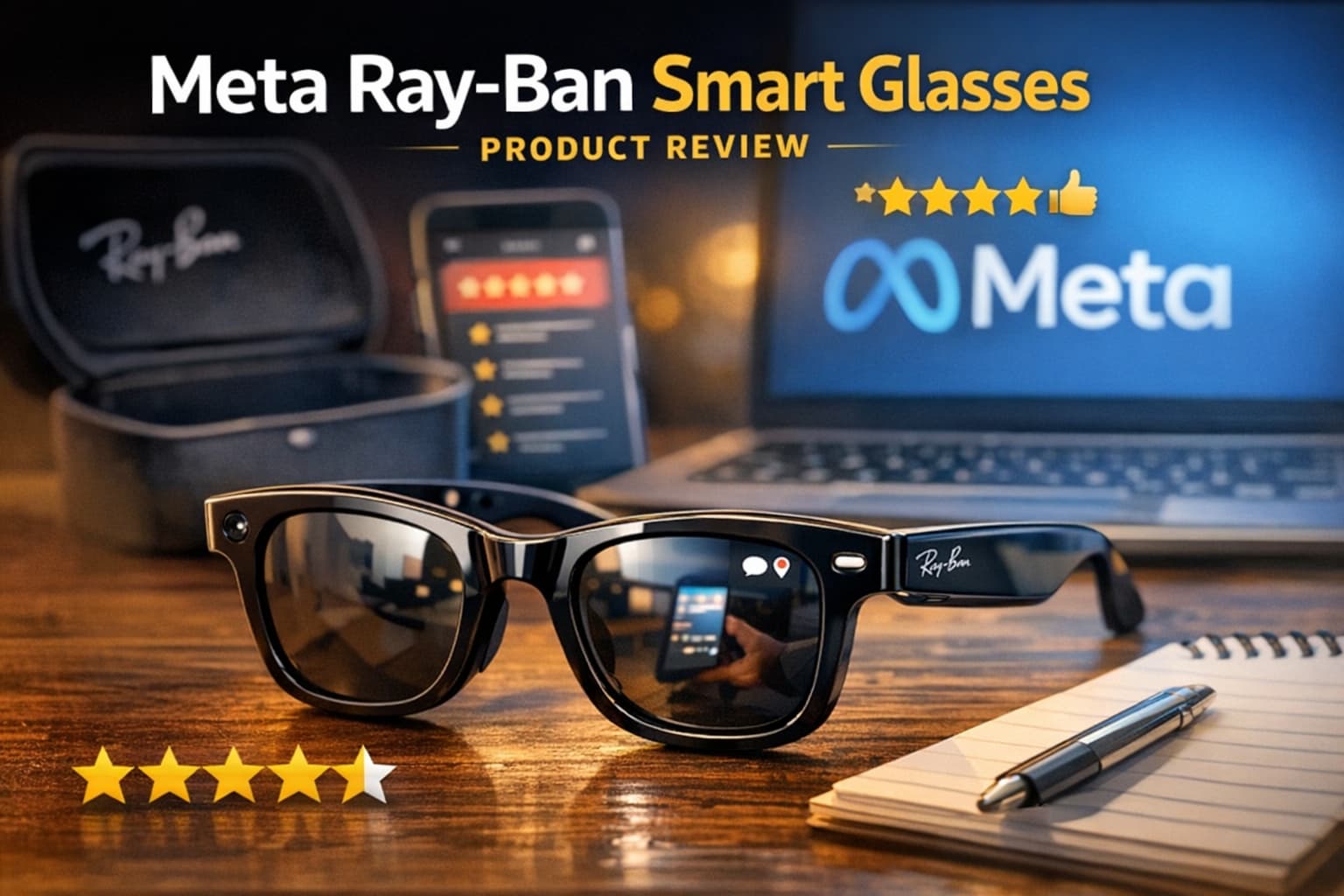
Image source: Meta
Meta Ray-Ban Smart Glasses Review: The Best Entry Point Into Smart Eyewear
Bottom line: The Ray-Ban Meta Smart Glasses (Gen 1) are the closest thing to mainstream smart glasses that actually exist today. They look like normal Ray-Bans, they don't require charging a separate controller, and the Meta AI integration has genuinely matured into something useful. If you're new to smart glasses and want something you can wear every day without looking ridiculous, this is the one.
Quick Specs
| Spec | Details |
|---|---|
| Price | From $299 (standard) / from $379 (prescription-ready) |
| Weight | ~49g (varies by frame style) |
| Camera | 12MP ultra-wide, up to 60-second video at 1080p |
| Audio | Open-ear directional speakers, 5 microphones |
| Battery | Up to 8 hours with case providing ~40 extra hours |
| Connectivity | Bluetooth 5.3, Wi-Fi 802.11b/g/n/ac |
| Companion App | Meta View (iOS/Android) |
| Frames | Wayfarer, Headliner, Skyler, Skyler Round, Plano |
| Water Resistance | IPX4 (splash resistant) |
Who These Are For
The Ray-Ban Meta glasses are built for people who want smart glasses that don't look like smart glasses. There's no heads-up display, no augmented reality overlay, no giant prism lenses. What you get is an iconic Ray-Ban frame — Wayfarer, Headliner, or a few others — with microphones, speakers, a camera, and Meta AI built into the temples.
The target user is someone who: listens to podcasts or music while walking, makes a lot of calls while commuting, wants hands-free photos and short videos, or is curious about AI voice assistants beyond what their phone already offers.
Design and Build Quality
This is where Meta and Ray-Ban got things genuinely right. The glasses look exactly like regular Ray-Bans. If you didn't know what you were looking at, you'd never notice the slightly thicker temples that house the electronics. The build quality feels premium — sturdy hinges, quality acetate frames, and lenses that hold up to daily wear.
The temples are noticeably thicker than standard glasses, which some people find uncomfortable if they wear over-ear headphones at the same time. The LED indicator light on the front right lens illuminates when recording, which is Meta's privacy concession — bystanders can theoretically tell you're capturing. Whether that's noticeable in practice is debatable.
Weight at ~49g is on par with heavier prescription eyewear and lighter than any AR display glasses. After a few days, you stop noticing them.
The charging case is a small clamshell that holds enough charge for multiple top-ups. The case itself charges via USB-C.
Core Features
Open-Ear Audio
The directional speakers project sound into your ears without plugging them. Audio quality is acceptable for podcasts, phone calls, and casual music listening — but you won't mistake it for earbuds. Bass is minimal, treble can be harsh at higher volumes, and sound leaks noticeably to nearby people.
The 5-microphone array handles calls impressively well. People on the other end regularly can't tell you're wearing glasses rather than holding a phone.
Camera
The 12MP ultra-wide camera captures photos with a single tap and records up to 60 seconds of 1080p video. The ultra-wide lens captures more scene than a standard phone camera, which is useful for first-person perspective content. Quality is adequate for social sharing — not a replacement for your smartphone camera, but genuinely usable.
Video is captured in the direction you're looking, which sounds obvious but matters: it means your perspective video is stable and natural in a way that selfie-stick footage isn't.
Livestreaming to Instagram and Facebook is supported directly through the Meta View app.
Meta AI
This is the feature that has improved most dramatically over the course of Gen 1's lifecycle. The "Hey Meta" wake word activates the AI assistant, which can:
- Describe what the camera sees ("What's this plant?")
- Answer general questions via voice
- Send messages, make calls, and set reminders via phone integration
- Translate text it can see in real time
The AI responses in 2025 are substantially faster and more accurate than at launch. The "Look and Ask" feature — where you ask about something in your field of view — works reliably for common queries like identifying products, reading menus, or getting directions.
It doesn't always work. In noisy environments, "Hey Meta" triggers inconsistently. The AI occasionally misunderstands context. But day-to-day, for voice-first tasks, it delivers.
Day-to-Day Use
After a week of daily wear, the pattern that emerges is: you use the audio features constantly and the camera occasionally. The glasses become a comfortable replacement for one earbud — you stay situationally aware while still getting audio — and Meta AI handles a surprising number of "I'd normally pull out my phone for this" moments.
The battery life claim of 8 hours is realistic for mixed use (calls, music, occasional AI queries). If you're mostly on calls, you'll get less. The charging case habit takes a day or two to establish, after which running out of battery becomes unusual.
The biggest daily friction point is the audio quality ceiling. For commuters who want immersive sound, these glasses don't replace earbuds. For workouts, the IPX4 rating means sweat won't kill them, but they're not designed as sports glasses.
Pros
- Looks like normal Ray-Bans — genuinely wearable in professional and social contexts
- Meta AI voice assistant is genuinely useful and has improved significantly post-launch
- 8-hour battery with charging case covers a full day of mixed use
- 5-microphone array makes calls sound clear on both ends
- IPX4 splash resistance handles rain and sweat
- Prescription lens compatible (through Ray-Ban's partner network)
- Camera livestreaming to Instagram/Facebook works directly
Cons
- Audio quality doesn't match real earbuds — tinny bass, audible sound leakage
- No display — no AR, no notifications in your vision, no heads-up anything
- Camera LED is legally required in some regions but bystanders often don't notice it
- Requires Meta account — privacy trade-off worth considering
- Works best with Meta ecosystem — some features need Facebook/Instagram
- Chunky temples can conflict with some hat styles and over-ear headphones
- No noise cancellation for audio
Who Should Buy These
Buy them if you:
- Want the most normal-looking smart glasses available
- Primarily want hands-free audio and voice assistant access
- Are interested in first-person video/photo capture
- Want prescription lens compatibility
- Are new to smart glasses and want the least friction entry point
Skip them if you:
- Want any kind of heads-up display or AR overlay
- Need audiophile-quality sound (get actual earbuds)
- Are concerned about Meta's data practices
- Regularly wear over-ear headphones (temple thickness conflict)
- Need more than 60 seconds of continuous video recording
Pricing and Where to Buy
The Meta Ray-Ban Smart Glasses start at $299 for standard lenses (sunglasses or clear). Prescription-compatible frames start higher depending on lens type. Available directly from Ray-Ban's website, Meta's store, and major retailers including Amazon and Best Buy.
As of mid-2025, Gen 1 pricing has become more competitive now that Gen 2 exists — check for discounts.
Final Verdict
4.2 / 5
The Meta Ray-Ban Smart Glasses succeed at something no smart glasses product had previously managed: they're normal-looking enough that ordinary people wear them in public, and the technology inside is useful enough to justify the price. Meta AI has transformed from a novelty into a genuinely practical assistant since launch, and the camera/audio combination covers 80% of what most people would want from smart glasses.
The audio quality ceiling and lack of any display are real limitations. If either of those matters to you specifically, there are better-suited alternatives. But as an everyday, wear-everywhere product? Nothing else on the market comes close to this combination of design and function.
Prices and availability current as of June 2025. Check Ray-Ban.com and Meta.com for current pricing and new color/style options.