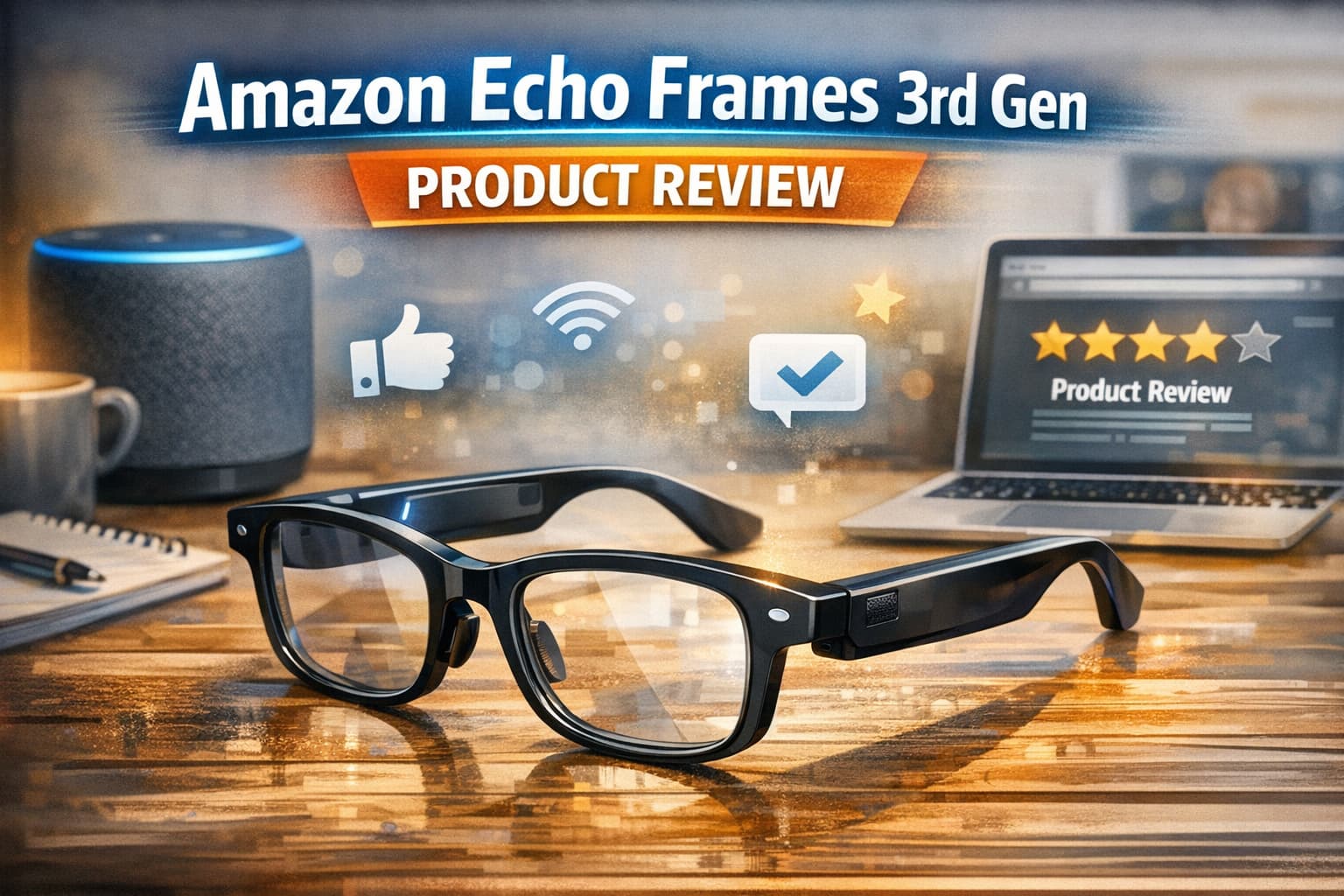
Image source: Amazon
Amazon Echo Frames (3rd Gen) Review: The Best Way to Live With Alexa
Bottom line: The Echo Frames 3rd generation are the most refined version of Amazon's smart audio glasses yet. Better looking, slimmer temples, improved audio, and Alexa is deeply useful if you're in the Amazon ecosystem. They're a solid choice for existing Alexa users who want hands-free access throughout their day. The audio quality still falls short of dedicated earbuds, and they're meaningfully better only if you're actually an Alexa user.
Quick Specs
| Spec | Details |
|---|---|
| Price | From $269 |
| Weight | ~31g |
| Audio | Open-ear directional speakers (improved from Gen 2) |
| Microphones | 4-mic array with VIP Filter |
| Battery | Up to 6 hours of continuous use, 14 days standby |
| Connectivity | Bluetooth 5.1 |
| Companion App | Alexa app (iOS/Android) |
| Frame Styles | Classic Rectangle, Geometric, Oval, Supra |
| Water Resistance | IPX4 |
| Smart Home Integration | Full Alexa ecosystem |
What's New in the 3rd Generation
Amazon's third generation of Echo Frames made meaningful improvements over the previous model:
- Slimmer temples — the most visible change; temples are noticeably less bulky
- More frame styles — added Geometric, Oval, and Supra shapes
- Improved audio — louder, slightly better quality speakers
- Better microphone array — more accurate Alexa wake word detection
- Longer battery — 6 hours versus ~5 hours in Gen 2
The core formula remains the same: open-ear speakers in the temples, Alexa always available via "Alexa" wake word, and no display or camera.
Design and Comfort
The 3rd generation design is the most glasses-like version Amazon has shipped. The slimmer temples reduce the "tech hardware" appearance significantly. On the Classic Rectangle style, a casual observer who doesn't know the product might not notice anything unusual.
Weight at ~31g is excellent — lighter than the Meta Ray-Ban frames and lighter than most prescription eyewear. Extended wear is genuinely comfortable.
Frame style variety is a genuine improvement: four styles with different face shape fits means more people find a frame that works for them. The Geometric and Oval options suit different face shapes than the original rectangular design.
Lenses are available in non-prescription clear, blue light filtering, and photochromic. Prescription lenses are available through Amazon's optical partner network for an additional cost.
Alexa Integration
This is the Echo Frames' core competency and where they justify their existence. If you use Amazon's ecosystem, Alexa from your glasses is a different experience than Alexa from a room speaker:
Always with you: Unlike a smart speaker, the Echo Frames are on your face. "Alexa, add milk to my shopping list" works walking to the store. "Alexa, set a timer for 10 minutes" works while cooking. "Alexa, call Mom" works driving (without touching a phone).
VIP Filter: A feature that uses a secondary mic beam to help Alexa focus on your voice rather than ambient noise. Works reasonably well — Alexa activates when you speak and less often from background TV or other voices.
Smart Home Control: Controlling lights, thermostats, door locks, and other smart home devices via voice from your glasses is the most friction-free implementation of smart home control available. You don't need to find your phone or yell at a speaker across the room.
Routines: Alexa Routines work from the glasses — automated sequences triggered by voice, time, or location.
Music and Podcasts: Amazon Music, Spotify, Apple Music (via Bluetooth), and podcast apps work through the glasses. Audio quality is the limiting factor here.
Audio Quality
The audio quality improvement from Gen 2 to Gen 3 is real but doesn't change the fundamental category: open-ear glasses speakers are not earbuds. The Echo Frames 3rd gen audio is:
- Adequate for phone calls — call quality is good, callers can't tell you're wearing glasses
- Fine for podcasts and audiobooks — clear voice audio, passable quality
- Okay for casual music — acceptable for background listening; lacks bass depth
- Not suitable for music you care about — don't expect satisfying playback for your favorite albums
- Noticeably audible to nearby people at higher volumes
Sound leakage at moderate to loud volumes is an issue in quiet offices or libraries. In noisy environments (commuting, walking outside), it's less noticeable but you also hear it less clearly.
The 4-mic array outperforms the speakers — calls sound consistently better to the recipient than music sounds to you.
Battery Life
The 6-hour continuous use claim is realistic for mixed use. Primarily voice commands and occasional music: you'll approach or exceed 6 hours. Continuous music playback depletes the battery faster. Standby time (glasses on, not actively using audio) is claimed at 14 days.
Charging uses a magnetic cradle — proprietary but reliable. A full charge takes about 1 hour 45 minutes.
The charging cradle doesn't double as a carrying case, unlike the Ray-Ban Meta's combo charging case. You need to carry the glasses in a separate case.
Compared to Meta Ray-Ban Smart Glasses
The natural comparison. Key differences:
| Feature | Echo Frames 3rd Gen | Ray-Ban Meta |
|---|---|---|
| Price | $269 | $299 |
| Weight | ~31g | ~49g |
| AI Assistant | Alexa | Meta AI |
| Camera | ❌ None | ✅ 12MP |
| Styles | 4 frame styles | 5 frame styles |
| Ecosystem | Amazon | Meta/Facebook |
| Audio Quality | Slightly better | Good |
The Echo Frames are lighter and cheaper but lack the camera. The Ray-Ban Meta's Meta AI is arguably more capable for visual AI tasks and natural conversation. Choose Echo Frames if you're invested in Alexa/Amazon ecosystem. Choose Ray-Ban Meta if you want the camera and better AI.
Day-to-Day Use
The Echo Frames fit a specific role well: constant low-friction Alexa access throughout your day. Users who report the highest satisfaction are:
- Smart home power users: Controlling everything via glasses voice commands
- People who hate stopping to look at their phone: Getting information via voice without interruption
- Existing Alexa households: Already have Amazon ecosystem habits
- People who prioritize comfort: 31g is extremely light for all-day wear
Common friction points: You must remember to say "Alexa" (not "Hey Siri" or "OK Google"). In noisy environments, wake word detection is inconsistent. Audio quality is a constant reminder that these aren't earbuds.
Pros
- Very lightweight at ~31g
- Alexa deeply integrated — best implementation of a voice assistant in glasses
- Smart home control is a genuine daily use case for Amazon ecosystem users
- Slimmer temples than Gen 2 — more normal-looking
- More frame style options than previous generation
- 6-hour battery covers most workdays
- Good call quality despite open-ear design
Cons
- No camera — can't do visual AI or photo capture like Ray-Ban Meta
- Audio quality limited compared to earbuds
- Sound leakage in quiet environments
- Proprietary charging cradle not shared with other devices
- Alexa-only — no switching to Siri or Google Assistant
- Limited visual ecosystem appeal without Amazon Prime, smart home devices
- No display of any kind
Who Should Buy These
Buy them if you:
- Already use Alexa extensively at home
- Want smart glasses primarily for voice commands and calls
- Prioritize lightweight comfort (31g is genuinely impressive)
- Control smart home devices and want that while not home
- Are price-conscious ($269 vs $299 for Ray-Ban Meta)
Skip them if you:
- Don't use Alexa or Amazon devices
- Want a camera or any visual capability
- Want better audio quality (get proper earbuds)
- Are primarily an Apple or Google Assistant user
- Want Meta AI's more conversational assistant
Pricing and Where to Buy
The Echo Frames 3rd Gen starts at $269 and is available at Amazon.com and select retail partners. Prescription lenses available through Amazon's partner program for additional cost. Check Amazon regularly for deals — Echo hardware frequently discounts.
Final Verdict
3.5 / 5
The Echo Frames 3rd Gen are the best version of Amazon's smart glasses vision. The design improvements make them genuinely wearable, and for the right user — someone deep in the Alexa/Amazon ecosystem who wants constant voice assistant access — they're an excellent product.
The limitations are honest ones: no camera limits the AI's capabilities, audio quality is the inherent constraint of open-ear glasses speakers, and if you're not an Alexa user, there's no reason to buy these over the Ray-Ban Meta. But for their intended user, they deliver better than the competition.
Prices current as of June 2025. Amazon regularly runs promotions on Echo hardware — check amazon.com for current pricing.